The sensor of the clamp connected vortex flowmeter is a new type of flow meter manufactured using the Karman vortex principle. The output signals are pulse signals and standard current signals, which measure the instantaneous and cumulative flow rates of liquids, gases, and vapors in pipelines. It is currently an ideal automation detection instrument, available in ordinary, explosion-proof, and on-site display types. The clamp vortex street is suitable for many health industries.
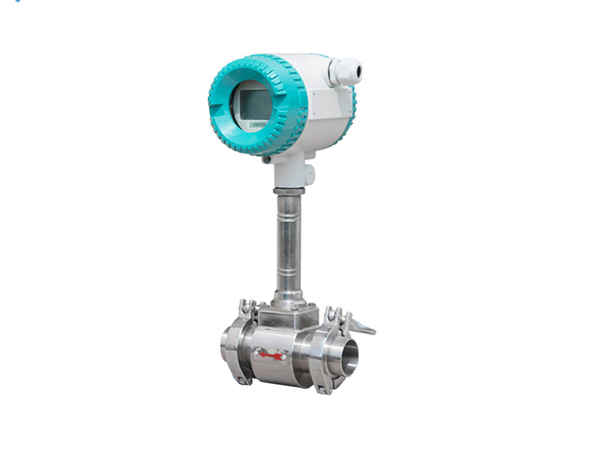
Manufacturer of clamp connected vortex flowmeter
Clamp connected vortex flowmeters are widely used in the process measurement and energy-saving management of various low viscosity single-phase fluids such as liquids, gases, steam, etc. in industries such as petroleum, chemical, metallurgical, mechanical, papermaking, as well as urban pipeline heating, water supply, and gas.
The clamp connected vortex flowmeter overcomes the disadvantages of high usage cost, complicated operation, and low efficiency caused by the need to evenly distribute bolt holes on the connecting plate and use bolts and nuts to fix the connecting plate to the pipeline for general flowmeter joints. Instead, it adopts a connecting plate with a right angled trapezoidal cross-section and a right angled trapezoidal oblique edge on the inner side. When in use, the connecting plate is fastened to the pipeline using clamps, which is cost-effective, time-saving, and labor-saving. Clamp type flow meters are mainly used in high complexity work environments such as oil fields.
The clamp type vortex flowmeter overcomes the disadvantages of high usage cost, complicated operation, and low efficiency caused by the need to evenly distribute bolt holes on the connecting plate and use bolts and nuts to fix the connecting plate to the pipeline for general flowmeter joints. Instead, it adopts a connecting plate with a right angled trapezoidal cross-section and a right angled trapezoidal oblique edge on the inner side. When in use, the connecting plate is fastened to the pipeline using clamps, which is cost-effective, time-saving, and labor-saving.
Principle of clamp type vortex flowmeter
A clamp type vortex flowmeter is a volumetric flowmeter that measures the volumetric flow rate, standard condition volumetric flow rate, or mass flow rate of gases, vapors, or liquids based on the Karman vortex principle. And it can be used as a flow transmitter in automation control systems.
The vortex flowmeter applies the principle of fluid oscillation to measure flow rate. When the fluid passes through the vortex flowmeter in the pipeline, two columns of vortices proportional to the flow velocity are alternately generated up and down behind the vortex generator in the triangular column. The release frequency of the vortices is related to the average velocity of the fluid flowing through the vortex generator and the characteristic width of the vortex generator, which can be expressed by the following equation:
In the formula: is the release frequency of the vortex, in Hz; V is the average velocity of the fluid flowing through the vortex generator, measured in m/s; D is the characteristic width of the vortex generator, measured in meters; St is a Strouhal number, dimensionless, with a numerical range of 0.14-0.27.
St is a function of Reynolds number.
When the Reynolds number Re is within the range, the St value is about 0.2. In measurement, it is important to meet the Reynolds number of the fluid as much as possible, at which point the vortex frequency is.
Thus, by measuring the vortex frequency, the average velocity v of the fluid flowing through the vortex generator can be calculated, and the flow rate q can be obtained from the equation, where A is the cross-sectional area of the fluid flowing through the vortex generator.
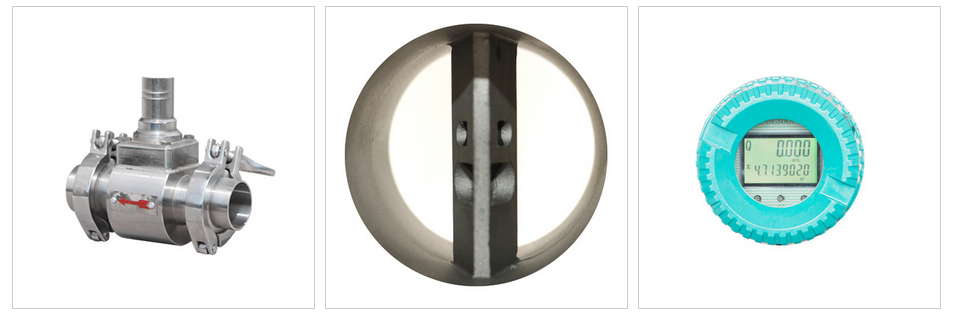
Technical parameters
| property | Technical parameter |
| Measuring medium | Gas, liquid, vapor |
| Caliber specification | DN25-300 |
| Flow measurement range | Normal flow rate range gas 5 ~ 50m/s; Liquid 0.5 ~ 7m/s |
| Measurement accuracy | Level 1.0 Level 1.5 |
| Temperature of the measured medium | Room temperature -25℃ ~ 10℃ High temperature -25℃ ~ 150 ℃ -25℃ ~ 250℃ |
| material | 304 stainless steel |
| Power source | DC24V or lithium battery 3.6V |
| Explosion-proof class | Intrinsically safe iaIIbT3-T6 |
| Class of protection | IP65 |
How to select productss
Correct selection is necessary to ensure better use of the clamp connected vortex flowmeter. What type of vortex flowmeter should be selected based on the physical and chemical properties of the measured fluid medium? What are the diameter, flow range, lining material, electrode material, and output current of the vortex flowmeter? Can adapt to the properties of the measured fluid and the requirements of flow measurement.
- Precise functional inspection
The accuracy level and function of the instrument are selected based on measurement requirements and usage scenarios to achieve cost-effectiveness. For example, in situations such as trade settlement, product handover, and energy measurement, higher accuracy levels such as 1.0, 0.5, or higher should be selected; For process control applications, choose different accuracy levels according to control requirements; In some cases where only the process flow is detected without the need for control and measurement, a slightly lower accuracy level, such as 1.5, 2.5, or even 4.0, can be selected. In this case, a low-cost plug-in vortex flowmeter can be used.
- Measurable media
When measuring medium flow rate, instrument range, and caliber for general medium measurement, the full flow rate of the vortex flowmeter can be selected within the range of 0.5-12m/s for measuring medium flow rate, which is relatively wide. The selection of instrument specifications (caliber) may not necessarily be the same as the process pipeline, and should be determined based on whether the measured flow range is within the flow rate range. That is, when the pipeline flow rate is too low to meet the requirements of the flow instrument or the measurement accuracy cannot be guaranteed at this flow rate, the instrument port diameter needs to be reduced to increase the flow rate inside the pipeline and obtain satisfactory measurement results.
- Selection of Vortex Flow Transmitter
In saturated steam measurement, VA type piezoelectric vortex flowmeter is used. Due to the wide range of the vortex flowmeter, in practical applications, it is generally considered that the flow rate of saturated steam should not be lower than the lower limit of the vortex flowmeter, which means that the fluid flow velocity must not be lower than 5m/s. Choose vortex flow transmitters with different diameters based on the amount of steam used, rather than selecting the transmitter diameter based on the existing process pipeline diameter.
- Selection of pressure compensation pressure transmitter
Due to the long saturated steam pipeline and significant pressure fluctuations, pressure compensation must be used. Considering the correspondence between pressure, temperature, and density, only pressure compensation is required for measurement. As the saturated steam pressure in the pipeline is in the range of 0.3-0.7MPa, the range of the pressure transmitter can be selected as 1MPa.
- Display instrument selection
Intelligent flow display instrument with voltage stabilization compensation, instantaneous flow display, and cumulative flow calculation functions.
Application field
The clamp connected vortex flowmeter is applied in the process measurement and energy-saving management of various low viscosity single-phase fluids such as liquids, gases, steam, etc. in industries such as petroleum, chemical, metallurgical, mechanical, papermaking, as well as urban pipeline heating, water supply, and gas.