Ultrasonic level meters is a digital level instrument controlled by a microprocessor. In measurement, ultrasonic pulses are emitted by sensors (transducers), and the sound waves are reflected by the liquid surface and received by the same sensor. They are converted into electrical signals by piezoelectric crystals, and the distance from the sensor to the measured liquid surface is calculated based on the time between the emission and reception of the sound waves. Due to the use of non-contact measurement, the measured medium is almost unrestricted and can be widely used for measuring the height of various liquid and solid materials.
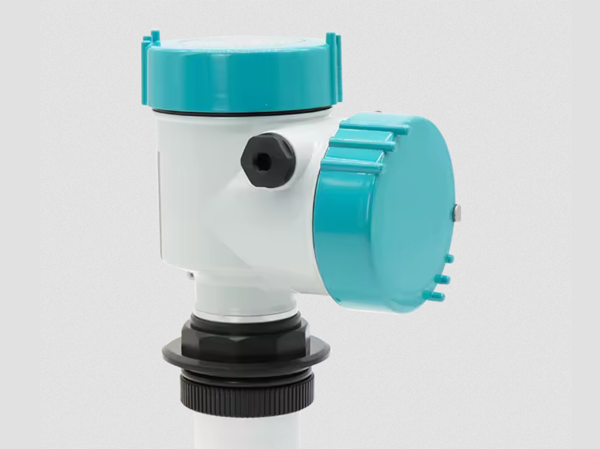
Manufacturer of level sensor ultrasonic level meters
Product features of ultrasonic level meters
Automatic power adjustment, gain control, temperature compensation.
Physically sealed probe, IP68 protection level, no water ingress, improves service life.
Special echo processing technology, available for troubleshooting in case of on-site malfunctions, and easy to maintain.
The suppression function with interference echo ensures the authenticity of measurement data and has strong anti-interference ability.
Multiple output forms: programmable relay output, high-precision 4-20mA current output, Rs-485, RS-232 digital communication output, wireless GPRS output, etc.
Low price, small size, light weight, suitable for non-contact level measurement of liquids and bulk solids in industries such as food, chemical, and semiconductor. It can also be used for remote level monitoring and pump control.
Working principle of ultrasonic level meters
The working principle of an ultrasonic level meters is that high-frequency pulse sound waves are emitted by an ultrasonic transducer (probe) and reflected back on the surface of the measured object (material), which is then received and converted into electrical signals by the transducer The propagation time of sound waves is directly proportional to the distance they travel to the surface of an object The relationship between sound wave transmission distance S, sound velocity C, and sound transmission time T can be expressed by the formula: S=C × T/2
Due to the certain width of the emitted ultrasonic pulses, the reflected waves in a small area close to the transducer overlap with the emitted waves, making it difficult to identify and measure their distance values. This area is called the measurement blind spot. The size of the blind spot is related to the model of the ultrasonic level meters.
The probe emits ultrasonic waves, which are reflected when encountering a medium with a significantly different density from air. The reflected waves are then received by the probe, and the distance from the probe to the liquid (object) surface is proportional to the time the ultrasonic waves pass through
Distance [m]=Time x Sound Speed/2 [m]
Temperature compensation formula for sound velocity: Environmental sound velocity=331.5+0.6 x temperature
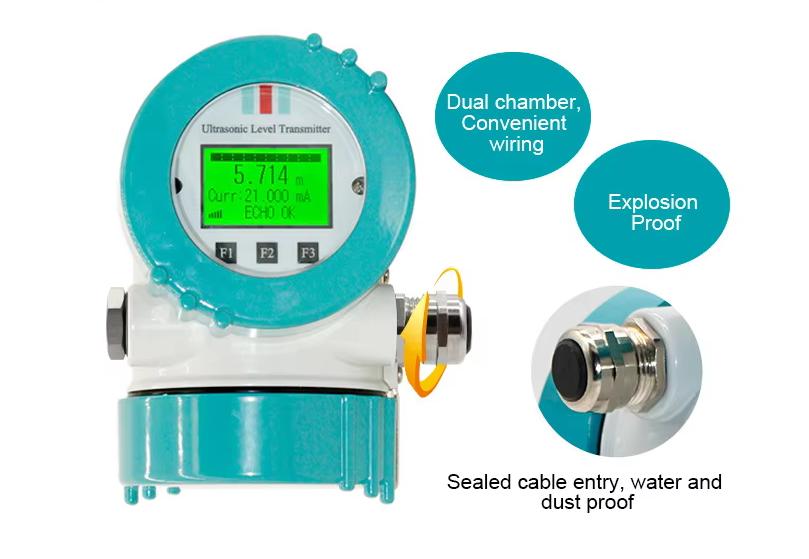
Ultrasonic level meters is a monitoring instrument that measures the height of liquid, tank height, and material position. The instrument itself can adopt two-wire, three wire or four wire technology. The two-wire system is: power supply and signal output are shared; The three wire system is: the power supply circuit and the signal output circuit are independent. When using DC 24V power supply, a 3-core cable can be used, and the negative end of the power supply and the negative end of the signal output share the same core wire; The four wire system is: when using AC 220V power supply, or when using DC 24V power supply and requiring complete isolation between the power supply circuit and the signal output circuit, a 4-core cable should be used. DC or AC power supply, with 4-20mADC and high/low switch output.
Installation principle of ultrasonic level meters
The installation of ultrasonic level meterss must consider the blind spot issue of ultrasonic level meterss. When the liquid level enters the blind zone, the ultrasonic level meters cannot measure the liquid level. Therefore, when determining the range of the ultrasonic level meters, a margin of 50 centimeters must be left, and the probe must be installed about 50 centimeters above the highest liquid level. This is the only way to ensure accurate monitoring of the liquid level and ensure the safety of the ultrasonic level meters.
In practical use, due to inadequate installation, the liquid level meters was completely submerged by water, resulting in complete damage to the gauge. Therefore, the highest liquid level value of the measured liquid should be considered.
During mechanical installation, attention should be paid to: the installation should be perpendicular to the surface of the test object to avoid measuring objects with foam properties, and the installation should not be less than the blind zone distance from the surface of the measurement object (blind zone: each product will have a standard, which will be known with the product). The beam should avoid blocking objects and not meet the tank mouth and container wall. When detecting large solids, the probe should be adjusted to reduce the measurement error.
Application fields of ultrasonic level meters
Water and sewage treatment: pump room, collection well, biochemical reaction tank, sedimentation tank, etc.
Electricity, mining: mortar pool, coal slurry pool, water treatment, etc.
Performance characteristics of ultrasonic level meters
Has strong anti-interference ability. The upper and lower limit nodes and online output adjustment can be set arbitrarily, with on-site display. Analog quantity, switch quantity, and RS485 output can be selected for convenient interface with related facilities.
Adopting polypropylene waterproof shell. The shell is compact and quite sturdy, with excellent chemical resistance. It has almost no destructive effect on inorganic compounds, regardless of acid, alkali, or salt solutions, except for strongly oxidizing materials. It is insoluble in almost all solvents at room temperature and can be used on media such as alkanes, hydrocarbons, alcohols, phenols, aldehydes, and ketones.
Non toxic. It can be used for the installation and maintenance of equipment in the pharmaceutical and food industries.