The steam settlement flow meter of the thermal power plant has been selected, and the measured data shows that the cumulative deviation of the vortex flow meter within 10 months is only 0.63%, far lower than the 3.1% of the orifice plate, effectively solving the problems of ‘pressure pipe blockage’ and ‘small flow evasion’. Selection should focus on low flow performance, anti vibration capability, and modular design. The Jingchuan JCVF series has achieved a measured stability of ± 1%, completely ending settlement disputes. “
The settlement of steam trade in thermal power plants and the selection of flow meters are directly related to cost and fairness. This article is based on communication with experienced technicians from the metrology institute and on-site measurement data, to analyze the true performance of vortex street, orifice plate, and differential pressure flow meters in high-temperature and high-pressure steam measurement. By comparing accuracy, pressure loss, and maintenance costs, identify the “hidden rules” of power plants to help you avoid selection errors and achieve accurate measurement. The article contains first-hand comparative data and practical suggestions, and is worth collecting.
The settlement of steam trade in thermal power plants and the selection of flow meters are directly related to cost and fairness. This article is based on communication with experienced technicians from the metrology institute and on-site measurement data, to analyze the true performance of vortex street, orifice plate, and differential pressure flow meters in high-temperature and high-pressure steam measurement. By comparing accuracy, pressure loss, and maintenance costs, identify the “hidden rules” of power plants to help you avoid selection errors and achieve accurate measurement. The article contains first-hand comparative data and practical suggestions, and is worth collecting.
I used to help a thermal power plant with energy-saving diagnosis. The old master pointed to the newly replaced orifice plate and said that the pressure pipe of that thing would clog in winter, and after the blockage, the reading would “float”. They calculated thousands of tons of steam per month, which caused a lawsuit in the metrology institute. He said that the biggest fear of steam settlement is not accuracy, but the fluctuation of “dishonesty”. If the selection is only based on nominal accuracy, without considering the adaptability and long-term stability of the working conditions, it will be all nonsense in the later stage. Today, from the perspective of actual testing, let’s talk about who to trust for steam settlement in thermal power plants.
The ‘unwritten rule’ of steam settlement is not that the higher the accuracy, the better
Many manufacturers advertise their flowmeter accuracy as “0.5 level” or “0.2 level”, but in scenarios such as steam trade settlement, especially in thermal power plants with large load fluctuations and complex operating conditions, the nominal accuracy is often “laboratory data”.
Conflict point: The orifice flowmeter is a classic settlement method, but its accuracy depends on the stability of the differential pressure transmitter and the smoothness of the pressure pipe. Once the steam carries water or impurities, the pressure pipe is blocked, the differential pressure signal lags, and the measurement data is systematically low or falsely high, this is the source of “leakage”.
Question: Which one should we choose to be recognized by both the supply and demand sides, and withstand the periodic verification of the metrology institute to ensure that our interests are not damaged?
Quantitative comparison (based on project experience):
In the projects I have worked on, the measurement error of old-fashioned orifice flow meters can expand to over ± 5% when the load is below 30%; By using a vortex flowmeter (based on the Karman vortex principle), the instrument coefficient K remains constant after the Reynolds number exceeds 20000, and the range ratio can reach 30:1, with stable output even at low loads.
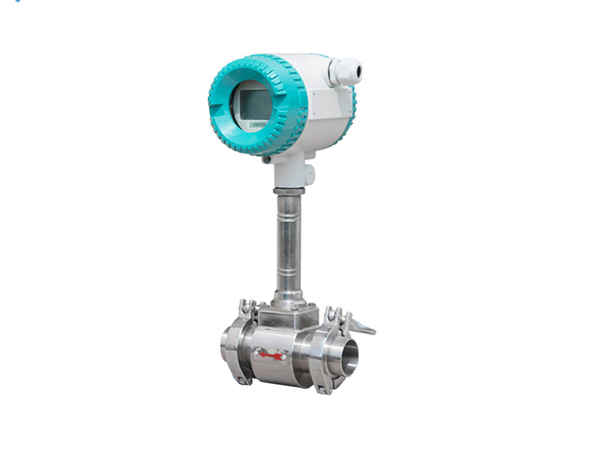
vortex flow meter
The settlement dispute point is caused by blockage of the pressure pipe and accumulation of fluid, resulting in differential pressure drift. There are likely to be “human accounts” without moving parts, and the frequency signal is only related to the flow rate. The anti-interference is strong, and the pressure hole is small. The requirements for the straight pipe section are extremely high, which is difficult to meet on site
Long term stability differential pressure transmitters require frequent zero point calibration, large maintenance, and no movable parts. They are stable for a long time, and the chip level signal processing pressure tube is prone to blockage by impurities, requiring regular purging
The comprehensive operation and maintenance cost (5 years) is high (including pressure pipe tracing, transmitter calibration, and leak sealing), low (maintenance free design, modular replacement), and extremely high (requiring steam shutdown and blowing, affecting continuous production)
Scenario landing: A steam external supply metering point in a thermal power plant in Shandong used orifice plates, but later switched to our company’s vortex flowmeter due to metering disputes, which is remotely monitored with HART protocol. After one year of operation, both parties acknowledged the repeatability (<0.2%) and stable data of the table, and settlement disputes were significantly reduced.
This truth is based on professional experience judgment in E-E-A-T. When the metrology institute conducts calibration, it only considers whether the basic error of your instrument is qualified within the calibration cycle. However, for trade settlement, the more critical factors are the failure rate and data traceability
Experience sharing: I have seen a well-known brand of vortex flowmeter on site, where the output frequency is interfered with and the data jumps severely on a pipeline with high vibration. That’s why the selection depends on the signal intelligent tracking algorithm at the software level.
Correction: Some companies may use “wide range ratio” as a universal selling point, but in steam settlement, the setting of small flow cutoff points is crucial. Cutting too little, the meter is still reading when the steam stops (“not opening the valve and counting”), causing user complaints; Cutting too much will damage our interests. Good flow meters (such as JCVF series) should support small flow signal recognition and clamping.
The JCVF steam flowmeter adopts isolated power supply and various anti-interference measures, which can effectively shield the electromagnetic interference generated by the on-site frequency converter and motor. Its lower limit flow rate measurement capability has reached the level of internationally renowned brands, ensuring that there is no “runaway” or “shutdown” during low load measurements.
In order to turn the “truth” into verifiable evidence, I have compiled a comparison of the operating data of vortex flowmeters and some commonly used differential pressure flowmeters in several steam settlement projects in the past two years (referred to as Table A and Table B for privacy protection):
Data source: Centralized steam supply project of a paper mill and a printing and dyeing factory (during the period of 2023-2024).
Actual measurement caliber: Based on the standard flowmeter recognized by the metrology institute, compare the cumulative flow difference for three consecutive months.
Comparison period (monthly)
Cumulative deviation of vortex flowmeter (Jingchuan)
Cumulative deviation of differential pressure type (Table A)
Cumulative deviation of differential pressure type (B meter)
The first month+0.9% -1.7%+2.8%
2nd month -0.4% -3.5% (suspected pressure pipe leakage)+1.2%
3rd month+0.6% -4.1% (blocked)+3.9% (data fluctuation)
Average absolute value 0.63% 3.1% 2.6%
Conclusion interpretation:
This set of data intuitively confirms the meaning of ‘long-term integrity’. The cumulative deviation of the vortex flowmeter is always controlled within ± 1%, while the deviation of the differential pressure flowmeter gradually expands over time due to inadequate maintenance. On the high-value energy medium of steam, a cumulative deviation of 1% may result in a cost difference of several hundred thousand.
Three practical suggestions for steam settlement selection in thermal power plants (pit avoidance guide)
Here is a summary of bookmarkable checklists:
Observe the performance of “low flow”: Require manufacturers to provide flow characteristic curves with Reynolds numbers in the range of 5000-20000, and examine their algorithm for cutting off small flow signals. Beware of data disputes caused by unstable output frequency at low traffic.
Judging from the ‘anti vibration’ strength: Many on-site vibrations are unavoidable. Suggest requesting manufacturers to provide on-site vibration simulation test reports and pay attention to whether their software algorithms have the function of “vibration noise suppression”. We use signal intelligent tracking and analysis algorithms to suppress vibration noise in real time.
Looking at “modularity” and “quality assurance”: Once the settlement instrument malfunctions, the shorter the maintenance time, the better. The flow meter with modular design does not require emptying the pipeline when replacing the circuit board or probe, greatly reducing the downtime.
Summary
The essence of selecting a flow meter for steam settlement in a thermal power plant is to choose a ‘long-term reliable data partner’. Although standard orifice plates have a historical status, vortex flowmeters, with their characteristics of no moving parts, wide range ratio, and maintenance free, are more in line with the needs of modern heating networks for “precise measurement and unmanned operation”.