Flow meters, as key instruments for measuring instantaneous or cumulative fluid flow in pipelines, are widely used for flow measurement of gases, liquids, steam and other media. In the field of industrial measurement, it plays a crucial role. With the continuous improvement of industrial productivity, more stringent requirements have been put forward for the range and accuracy of flow measurement, which has promoted the continuous innovation of measurement technology. In order to meet diverse application needs, various types of flow meters have emerged in the market, and according to statistics, there are currently over 100 types. These flow meters are usually classified according to the measured medium, structural principle, and measurement principle.
Classification of flowmeter
Flow meters, which play a crucial role in many occasions such as industry and laboratories, have a wide variety of types and functions. The classification of flow meters is usually based on three dimensions: the type of medium being measured, the structural principle, and the measurement principle. Next, we will delve into several common ways of classifying flow meters.
Firstly, according to the type of medium being measured, flow meters can be divided into liquid flow meters, gas flow meter, steam flowmeter, and solid flow meters. These flow meters are designed to measure different types of media, each with its unique application areas and characteristics.
Secondly, according to the structural principle of flow meters, they can be classified into volumetric flowmeter, differential pressure flowmeter, float flowmeter, turbine flowmeter, electromagnetic flowmeter, etc. These different types of flow meters have different working principles and applicable scenarios, providing users with a wide range of choices.
Among them, differential pressure flowmeter is an important type. Its working principle is that when the fluid in the full pipe enters the throttling device through a straight pipeline, the flow velocity will contract and accelerate at the throttling point, resulting in a decrease in static pressure and a differential pressure before and after the throttling element. This differential pressure is proportional to the flow rate, and the flow rate can be determined by measuring the differential pressure. Differential pressure flow meters have become one of the most widely used types of flow meters due to their simplicity, reliability, and wide applicability.
Float flowmeter, also known as rotor flowmeter, works by placing the float vertically in a vertical cone tube. When the fluid flows through the conical tube from bottom to top, the float will remain stationary in an equilibrium state, and the height of its equilibrium position is used for flow measurement. During the measurement process, the pressure drop before and after the float remains constant, while the flow rate is measured by changing the flow area. Therefore, the float flowmeter is often referred to as an area flowmeter, variable area flowmeter, or constant pressure drop flowmeter.
Positive displacement flow meters are known for their high precision in flow meters. It continuously and orderly cuts the fluid into several known volume parts through mechanical measuring elements, and uses a measuring chamber to sequentially fill and discharge these fluid parts to calculate the total volume. When the fluid passes through the flowmeter, a certain pressure difference will be generated at the inlet and outlet, which drives the internal components of the flowmeter to rotate and discharge the fluid. During this process, the fluid continuously fills the “measuring space” of the flowmeter and is then discharged in an orderly manner. By measuring the number of rotations, the cumulative volume of fluid passing through the flowmeter can be obtained.
The characteristics of volumetric flow meters include:
① High measurement accuracy and good repeatability;
② Loose installation environment requirements;
③ Wide measurement range and long service life;
④ Direct reading instrument, easy to operate and intuitive.
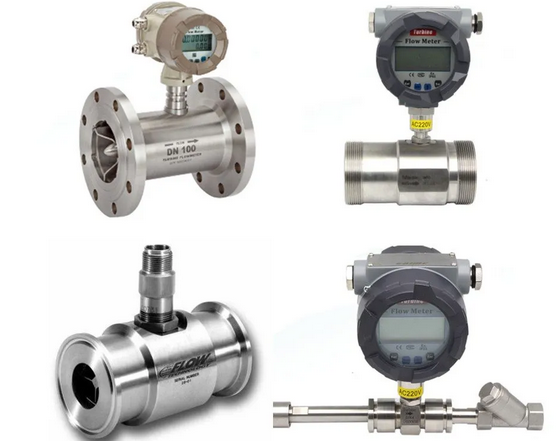
Turbine flowmeter, as a representative of velocity flowmeter, is a widely used instrument for flow measurement. Its working principle is that the fluid drives the turbine blades to rotate, thereby achieving measurement of flow rate. The key to this flowmeter is that there is a direct correlation between the rotational speed of the turbine and the fluid flow velocity.
Electromagnetic flowmeter, an instrument device based on the principle of electromagnetic induction, is widely used for measuring the flow rate of conductive liquids. Its working principle follows Faraday’s law of electromagnetic induction, by measuring the synergistic effect of components such as tube electrodes and force magnetic coils. When a conductive liquid flows in a magnetic field, it interacts with the magnetic field, resulting in induced electromotive force on the electrodes on both sides of the pipeline. This electromotive force is proportional to the flow velocity and can be detected by electrodes placed on both sides of the measuring tube wall, thereby achieving accurate calculation of liquid volume flow rate. Due to its excellent hygiene performance, it is often used in fields such as medicine, food, biochemistry, etc. that require strict hygiene conditions.
The working principle of a vortex flowmeter is to install a non streamlined vortex generator, such as a cylindrical object, in the fluid. When a fluid passes through a cylindrical object, regular vortices are alternately generated on both sides, which are called Karman vortex streets. Therefore, the flowmeter is named after this. The release frequency of Karman vortex street is closely related to the flow velocity of the fluid and the size of the column.
The ultrasonic flowmeter is designed using microprocessing technology, combined with integrated circuits and low-voltage wide pulse emission technology. It is particularly suitable for measuring liquid media, especially water. The accuracy level of this flowmeter reaches ± 1.0% and supports pressurized installation without shutdown. The host can be installed in the control room and can output standard signals such as current and pulse, and remotely transmit measurement data through RS232 or RS485 interfaces. In addition, the flowmeter also has the advantages of high reliability, low power consumption, anti-interference, and easy installation and maintenance.
The working principle of a mass flowmeter is to use an external heat source to heat the fluid inside the pipeline, so that the thermal energy flows along with the fluid. By measuring the changes in heat generated during fluid flow, i.e. temperature changes, the mass flow rate of the fluid can be reflected. In the case of constant fluid composition, the specific heat at constant pressure of the fluid is a known constant. Therefore, when the heating power remains constant, the mass flow rate can be calculated by measuring the temperature difference. In addition, the constant temperature difference method is also a commonly used method, which calculates the mass flow rate by maintaining a constant temperature difference between two points and then measuring the heating power. This method is simple and easy to implement, so it has been widely used in practice.
- Plug in flowmeter
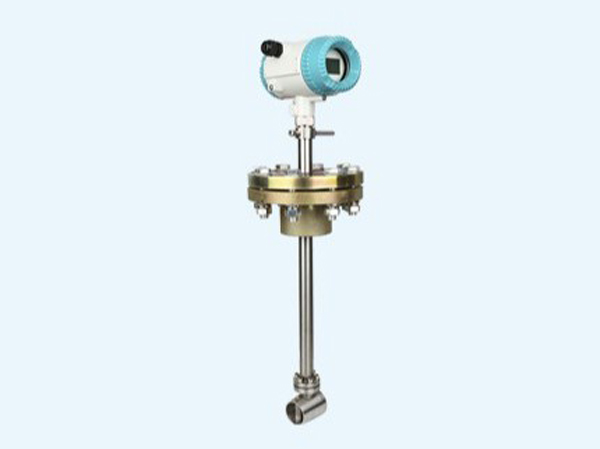
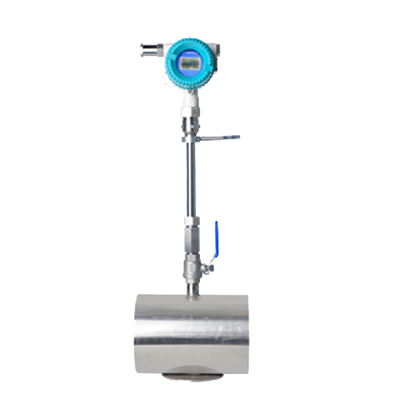
The principle of the plug-in flowmeter is based on Faraday’s law of electromagnetic induction. In an electromagnetic flowmeter, the conductive medium inside the measuring tube is similar to the conductive metal rod in Faraday’s test, with electromagnetic coils installed at both ends to generate a constant magnetic field. When a conductive medium flows in a pipeline, a voltage is induced, which is then measured by two electrodes inside the pipeline. To ensure the accuracy of the measurement, the measuring pipeline is electromagnetically isolated from the fluid and measuring electrodes through non-conductive lining (such as rubber or Teflon).
- Probe flowmeter
The principle of a probe flowmeter is to effectively transmit total pressure and static pressure to differential pressure and pressure sensors through probe holes and pressure conduits. As long as the probe hole remains unobstructed, even in the presence of debris or scale, accurate pressure transmission can be ensured without affecting measurement accuracy. In addition, due to the static state of the medium inside the pressure tube, the possibility of blockage caused by impurities entering is reduced, thus enabling high-precision measurement to be maintained for a long time.
Classification based on the principle of flow meter measurement
1) Mechanics principles: including differential pressure and rotor type instruments, which use Bernoulli’s theorem for measurement. In addition, there are impulse type and movable tube type, which are based on the momentum theorem; Direct mass equation, which applies Newton’s second law; Target type, based on the principle of fluid momentum; Worm gear type, utilizing the angular momentum theorem. Meanwhile, vortex and vortex street systems utilize the principle of fluid oscillation, while pitot tube systems are based on the total static pressure difference. Volumetric, weir, and trough types also belong to this category.
2) Electrical principles: This type of instrument includes electromagnetic, differential capacitive, inductive, and strain resistance types.
3) Acoustic principles: Ultrasonic and acoustic (shock wave) methods are typical examples of using acoustic principles for flow measurement.
4) Thermal principles: Instruments such as thermal, direct, and indirect calorimeters use thermal effects to measure flow rate.
5) Optical principles: Laser and photoelectric instruments are used to measure flow through optical technology.
6) Physical principles: Instruments such as nuclear magnetic resonance and nuclear radiation are used to measure flow using physical effects.
7) Other principles include labeling principles (such as tracing principles, nuclear magnetic resonance principles), related principles, etc., which also have a wide range of applications in specific fields.