How to Ensure the Flow Meter Is Installed Upstream of the Control Valve
The flow meter must be installed upstream of the valve, with sufficient straight pipe sections, to ensure accurate and stable measurements and prevent damage to the meter. Below, I will explain this in detail from several perspectives:
Why Must the Flow Meter Be Installed Upstream of the Valve
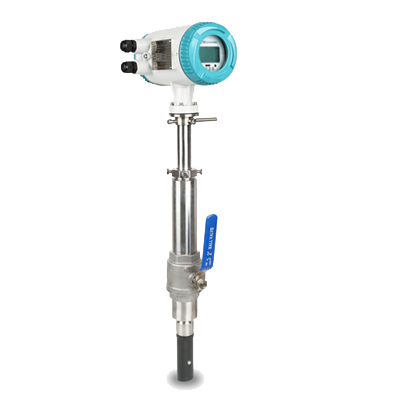
To avoid phase changes and two-phase flow
When a valve is adjusted, a sudden drop in pressure may cause liquid vaporization or gas separation, resulting in two-phase flow that directly disrupts the flowmeter’s measurement model. For example, a drop in pressure downstream of the valve may cause bubbles to form in a saturated liquid, whereas the higher and more stable pressure upstream effectively prevents phase changes.
Minimizing Pressure Fluctuations and Flow Disturbances
Valve operation can trigger downstream pressure pulsations and turbulence. If the flowmeter is installed downstream of the valve, these fluctuations can interfere with differential pressure or frequency measurements, leading to distorted readings. The upstream position offers more stable flow velocity and pressure, so valve disturbances have a minimal impact on the flowmeter, resulting in more stable measurements.
Meeting Straight Pipe Length Requirements
Flow meters typically require a certain length of straight pipe to ensure uniform velocity distribution. Turbulence or asymmetric flow patterns are prone to form downstream of a valve; if the straight pipe section is insufficient, measurement errors will increase. Installation upstream of the valve allows the upstream straight pipe section to optimize flow conditions, making it easier to meet specifications, especially when space is limited.How to Ensure the Flow Meter Is Installed Upstream of the Valve
Ensure Sufficient Straight Pipe Lengths
General Recommendation: The upstream straight pipe section should be ≥5 times the pipe diameter, and the downstream straight pipe section should be ≥3 times the pipe diameter.
When Space Is Limited: Flow straighteners can be added to reduce interference.
Special Flow Meters: For example, ultrasonic flow meters require an upstream straight pipe section of ≥10 times the pipe diameter and a downstream section of ≥5 times the pipe diameter.Avoid Sources of Interference
The installation point should be located away from potential sources of interference, such as valves, pumps, high-voltage power supplies, and variable frequency drives.

Avoid installing the flowmeter at the highest point of the piping system or on vertical pipes with free outlets.Consider Piping Configurations
If the upstream pipe contains a converging or diverging section, the length of the upstream straight pipe section must be increased based on the specific conditions to ensure the flow is fully developed before entering the flowmeter.

The length of the downstream straight pipe section should not be overlooked, as it also affects the flowmeter’s performance and measurement accuracy.Installation Considerations for Special Flowmeters
Electromagnetic Flowmeters: The installation location must be free of significant vibration sources, and reinforcement measures should be taken to stabilize the piping near the instrument; they must not be installed near equipment that generates strong magnetic fields, such as large transformers, electric motors, or pumps, to avoid interference from electromagnetic fields.
Vortex Flow Meters: Long straight pipe sections are required on both the upstream and downstream sides; the pipeline must be free of vibration. If vibration is present, mounting brackets must be installed on both sides of the flow meter.
Ultrasonic FlowMeter: Select pipe sections where the fluid is fully saturated, the material is uniform and dense, and conditions are conducive to ultrasonic transmission, such as vertical or horizontal straight pipe sections.Practical Case Study
At a fuel ethanol plant in Henan Province, an HKE electromagnetic flowmeter and a control valve were installed to precisely control the feed flow rate during the transfer of fermented ethanol solution to the vacuum distillation tower for distillation. In this case, the flowmeter was installed upstream of the valve, ensuring measurement accuracy and system stability.
IV. Summary
The primary purpose of installing a flowmeter upstream of a valve is to ensure measurement accuracy and extend equipment lifespan. When installing, keep three points in mind: provide sufficient straight pipe runs, avoid interference sources, and account for pipeline variations. By doing so, you can ensure that the flowmeter provides more accurate, stable, and durable measurements.